Brushless Motors vs the Alternatives: How to Choose
-
 2026.09.21
-
Uncategorized


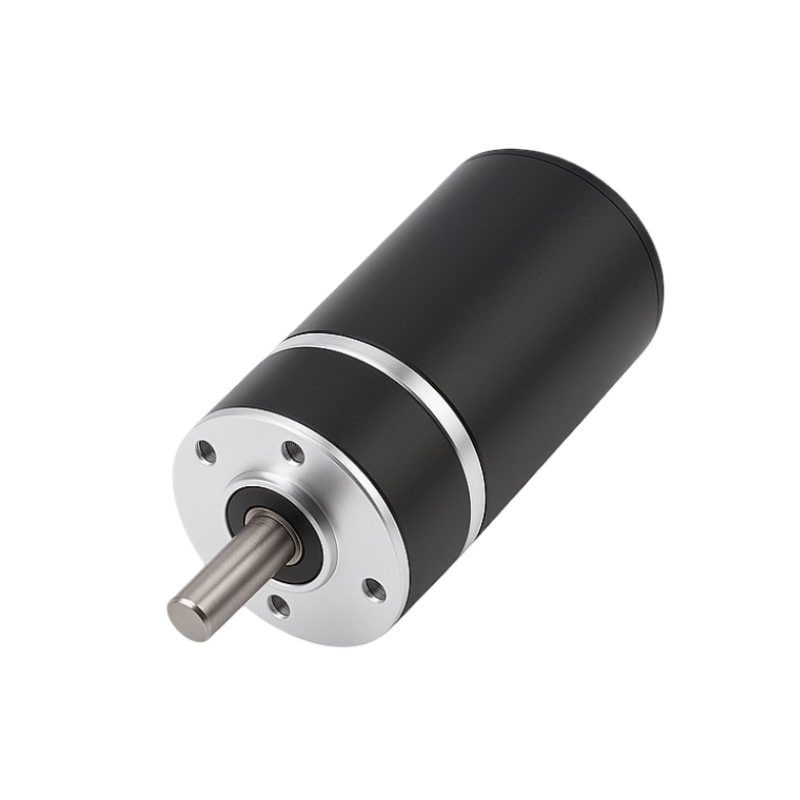
Comparing brushless motors vs the alternatives — brushed, coreless, stepper, servo, and AC — before choosing a specific part number saves rework later, because a gearbox spec, a controller board, and a housing design all follow from that choice. The comparison that actually drives a spec decision comes down to efficiency, lifespan, noise, cost, and control complexity.
Brushless (BLDC) Motors at a Glance
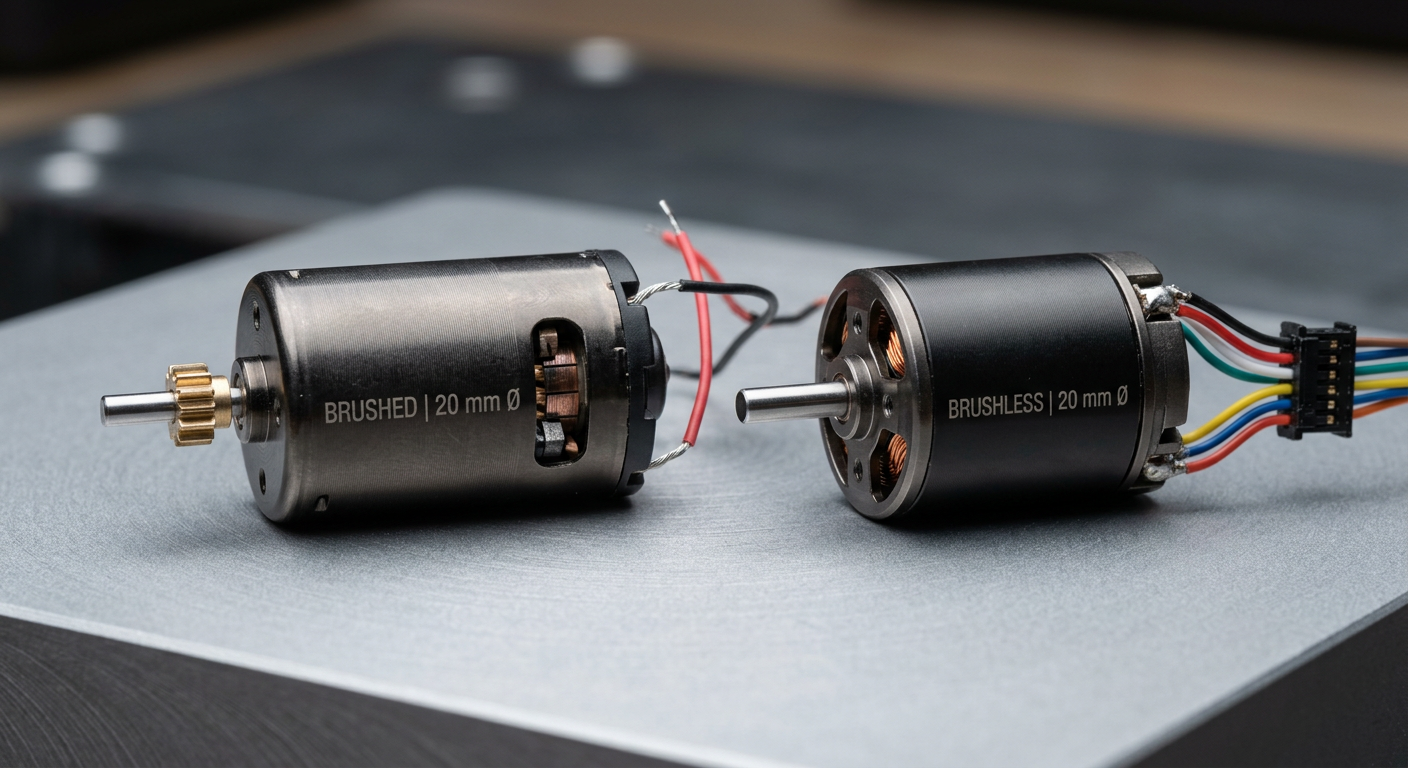
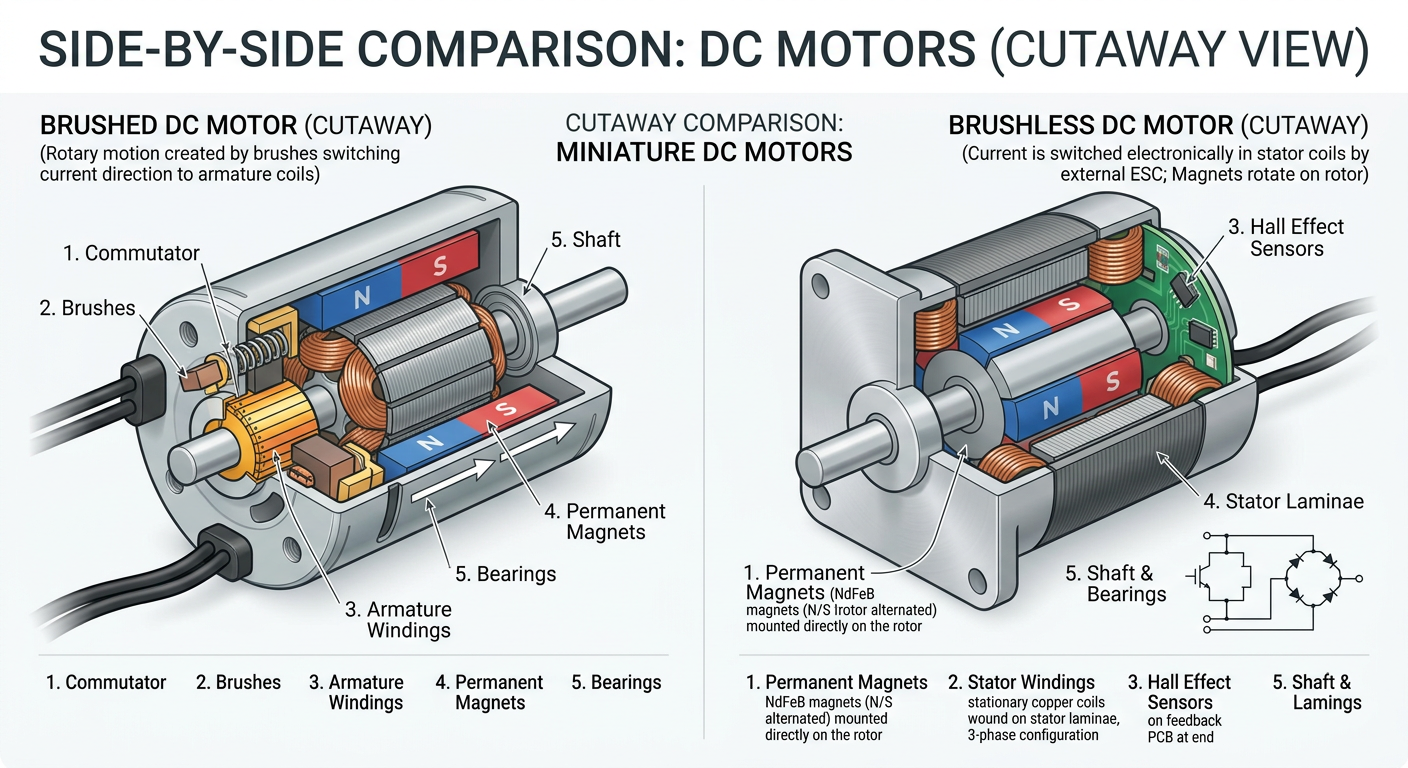
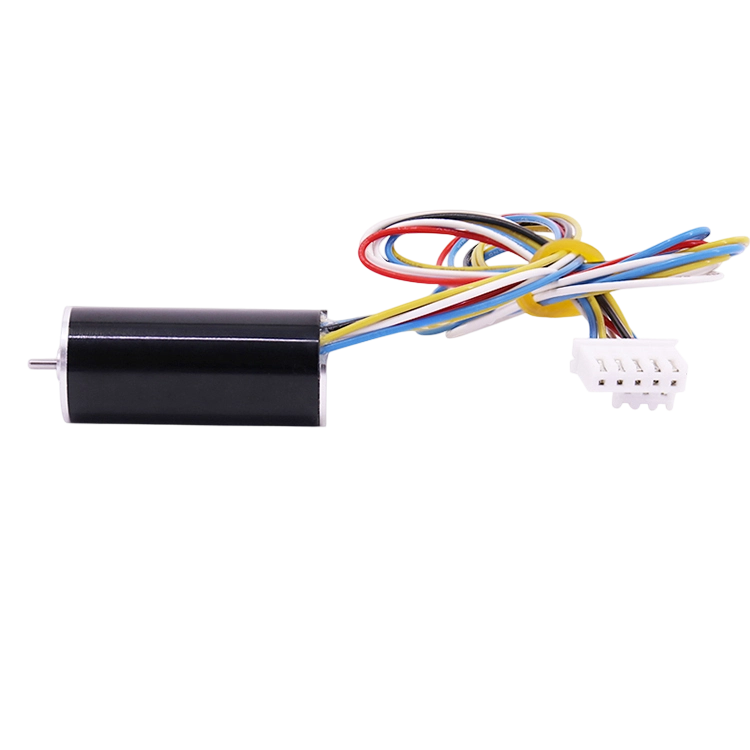
A brushless DC motor replaces the mechanical commutator and carbon brushes found in conventional DC motors with electronic commutation — a driver switches current through the stator windings in sequence, often using Hall sensors for rotor position feedback. No brushes means no brush wear and less friction; the trade-off is that a BLDC motor cannot run directly off a battery or a simple PWM circuit the way a brushed motor can — it needs a dedicated driver. As a category, brushless motors typically reach 85–90%+ efficiency under load, versus roughly 75–80% for brushed motors of comparable size. The brushless DC motor lineup spans roughly 16mm up to 60mm+ frame sizes with voltage configurations up to 48V, in sensored and sensorless variants.
Brushless vs. Brushed DC Motors
Brushed motors are the default low-cost, low-complexity option. Carbon brushes typically wear out within roughly 1,000–3,000 hours of continuous operation; brushless motors remove that wear point entirely, since there's no physical brush contact to degrade. A brushless motor plus its required driver typically costs about 2–3x an equivalent brushed motor, since the brushed motor can run directly off a battery or a simple PWM circuit with no added electronics. Brush contact also generates mechanical noise and some torque ripple at each segment transition; brushless motors trade that for electronic-switching noise that can raise EMI, though sinusoidal or FOC drive schemes reduce both the ripple and the interference.
| Criterion | Brushless (BLDC) | Brushed DC |
|---|---|---|
| Lifespan | Longer — no brush wear | Limited by brush wear, typically 1,000–3,000 hrs |
| Efficiency | ~85–90%+ | ~75–80% |
| Relative cost | ~2–3x brushed, including driver | Lowest — runs off simple PWM or direct battery |
| Noise / EMI | Switching noise, reducible with sinusoidal drive | Mechanical brush noise and segment ripple |
| Controller complexity | Requires electronic commutation driver | Simple H-bridge or direct drive |
Brushed motors trade a shorter service life for the simplest, cheapest drive electronics of any motor family, a trade-off worked through in DC brush motor vs alternatives and, from a purchasing angle, in the brushed vs brushless DC motors buyer's framework. The 20mm 180 series is one example that runs on 6V or 24V with no driver electronics at all — a fit for cost-sensitive, low-duty-cycle devices where a brushed DC motor makes more sense than a brushless one.
DC electric motors as a category trade some efficiency at very large scale for far simpler control electronics than AC drives, a comparison worked out in dc electric motor vs alternatives.
Brushless vs. Coreless DC Motors
Coreless is a rotor winding construction, not a commutation type — it removes the iron core from the rotor to cut rotational inertia, typically by around 90% versus an iron-core rotor of the same size. Coreless rotors exist in both brushed and brushless forms, so the coreless choice governs acceleration and response speed independently of whether the motor is brushed- or brushless-commutated.
Low rotational inertia makes coreless motors fast to accelerate and decelerate at small sizes, which is why they show up in handheld medical devices and camera actuators. Full brushless motors generally hold the advantage at larger frame sizes and higher continuous loads, where sustained torque and power density matter more than instant response. Whether the coreless premium pays off comes down to whether inertia or steady-state torque dominates the duty cycle, a calculation worked through in when coreless motors are worth the extra cost. Battery-powered medical devices favor coreless motors for exactly this reason — fast start-stop response without extra current draw, covered in coreless motors for battery-powered medical devices. The coreless DC motor range covers both brushed and brushless coreless configurations.
Brushless vs. Stepper, Servo, and AC Induction Motors
Standard stepper motors move in fixed increments — commonly 1.8° per step, 200 steps per revolution — and hold a fixed position with simple applied current, no feedback loop required. Brushless motors instead excel at continuous rotation and sustained efficiency, but need an added encoder and closed-loop control to position as precisely as a stepper does natively. Encoder-equipped brushless motors close that positioning gap against native stepper resolution, a trade-off measured in stepper vs. BLDC encoder positioning. Sizing either motor family for a robot joint starts with peak torque at stall, not just rated torque, a calculation walked through in specifying a micro gear motor for a robot joint. The stepper gear motor range covers frame sizes from 8mm up.
Servo motors are usually BLDC or PMSM motors paired with a high-resolution encoder and a closed-loop drive that regulates position, velocity, and torque together — the servo label describes the whole feedback system, not a separate winding technology. That closed-loop hardware pushes total system cost well above an open-loop BLDC setup of the same power rating, in exchange for tighter positioning accuracy on larger industrial axes. AC induction motors run directly off grid AC power without permanent magnets, which keeps per-unit cost low at large scale, but they run less efficiently at partial load and need a larger frame to match the torque density of a same-power BLDC motor — trade-offs that matter most at industrial-drive scale, well above the roughly 10mm–60mm micro and small-motor frame sizes that SLW Motor builds.
Decision Matrix — Which Motor Type Fits Your Application
| Criterion | Brushless (BLDC) | Brushed DC | Coreless | Stepper |
|---|---|---|---|---|
| Efficiency | ~85–90%+ | ~75–80% | High at small sizes | Moderate |
| Lifespan | Long — no brush wear | Limited by brush wear | Long, but winding is delicate | Long — few wear points |
| Noise | Low, smooth commutation | Some commutator noise | Very low | Audible at step frequency |
| Relative cost | ~2–3x brushed, plus driver | Lowest | Higher for the size | Moderate |
| Control complexity | Electronic commutation driver | Simple, direct drive | Driver required (brushed or BLDC) | Open-loop, or closed-loop with encoder |
| Best-fit use case | Continuous-duty pumps, fans, robotics drives | Cost-sensitive, low-duty-cycle devices | Rapid-response handheld/medical devices | Fixed-position, open-loop tasks |
Planetary gearboxes pack more torque into a smaller envelope than spur or worm designs, at a higher parts-count cost — a trade-off that applies on top of whichever motor family gets chosen, covered in planetary gear motor vs alternatives. Buyers still weighing between motor families can contact SLW Motor with target voltage, torque, and duty-cycle numbers for a specific recommendation.
Which Company DC Motor Is Best?
There's no single crowned winner — "best" depends on what the project needs. Before shortlisting a supplier, check for: quality certification (ISO 9001 at minimum); factory transparency (owned production floor vs. brokered subcontracting); customization range across voltage, torque, speed, and gearbox type; material options (brass, stainless steel, powder-metallurgy alloys, engineering plastics); years in operation and industries served; and sample-to-bulk flexibility without a large minimum order just to test a design.
Founded in 2012, SLW Motor is ISO 9001:2015 and RoHS certified and runs a 2,400 m² factory with 56+ staff, and its team carries 15+ years of combined industry R&D experience, including earlier work for manufacturing customers in Japan. Customization covers voltage, torque, gearbox type, and housing/gear material, with sample-to-bulk flexibility for buyers testing a new motor family — contact SLW Motor with specific voltage, torque, or gearbox requirements to evaluate against that checklist.
FAQ
Which company DC motor is best?
There's no universal winner — evaluate suppliers against a checklist: quality certification (ISO 9001 at minimum), factory transparency, customization range (voltage, torque, gearbox type, materials), years in operation, industries served, and flexibility from prototype samples through bulk production. Match the checklist to the project's actual requirements.
What is the main difference between brushless and brushed DC motors?
Brushed motors use physical brushes and a commutator to switch current through the rotor windings; brushless motors use electronic commutation controlled by a driver, with no brush contact. Brushless motors typically run at 85–90%+ efficiency versus 75–80% for brushed, and last longer since there's no brush wear point.
Is a coreless motor better than a brushless motor?
They're not directly comparable — coreless describes rotor construction, available in both brushed and brushless motors, while brushless describes commutation. Coreless rotors cut inertia by roughly 90% versus iron-core rotors, favoring rapid response at small sizes; full brushless motors favor sustained torque at larger sizes.
Brushless vs. stepper motor — which is better for robotics?
It depends on the joint's job. Stepper motors suit open-loop, fixed-position holding at lower cost, typically moving in 1.8° increments; brushless motors suit continuous rotation and higher sustained efficiency, but need an added encoder for precise closed-loop positioning.
Do brushless motors require a special controller or driver?
Yes. Without a mechanical commutator, an external driver must switch current through the stator windings in the correct sequence, typically using Hall sensor feedback for rotor position — this is a hard requirement, not an optional add-on.
Can brushless motors run without a Hall sensor?
Yes — sensorless brushless motors estimate rotor position electronically instead of using physical Hall sensors, trading some low-speed startup precision for a simpler, lower-component-count design. Sensored variants remain more common where precise low-speed control matters.