Planetary Gear Motor Explained: The Complete Guide
-
 2026.09.21
-
Uncategorized


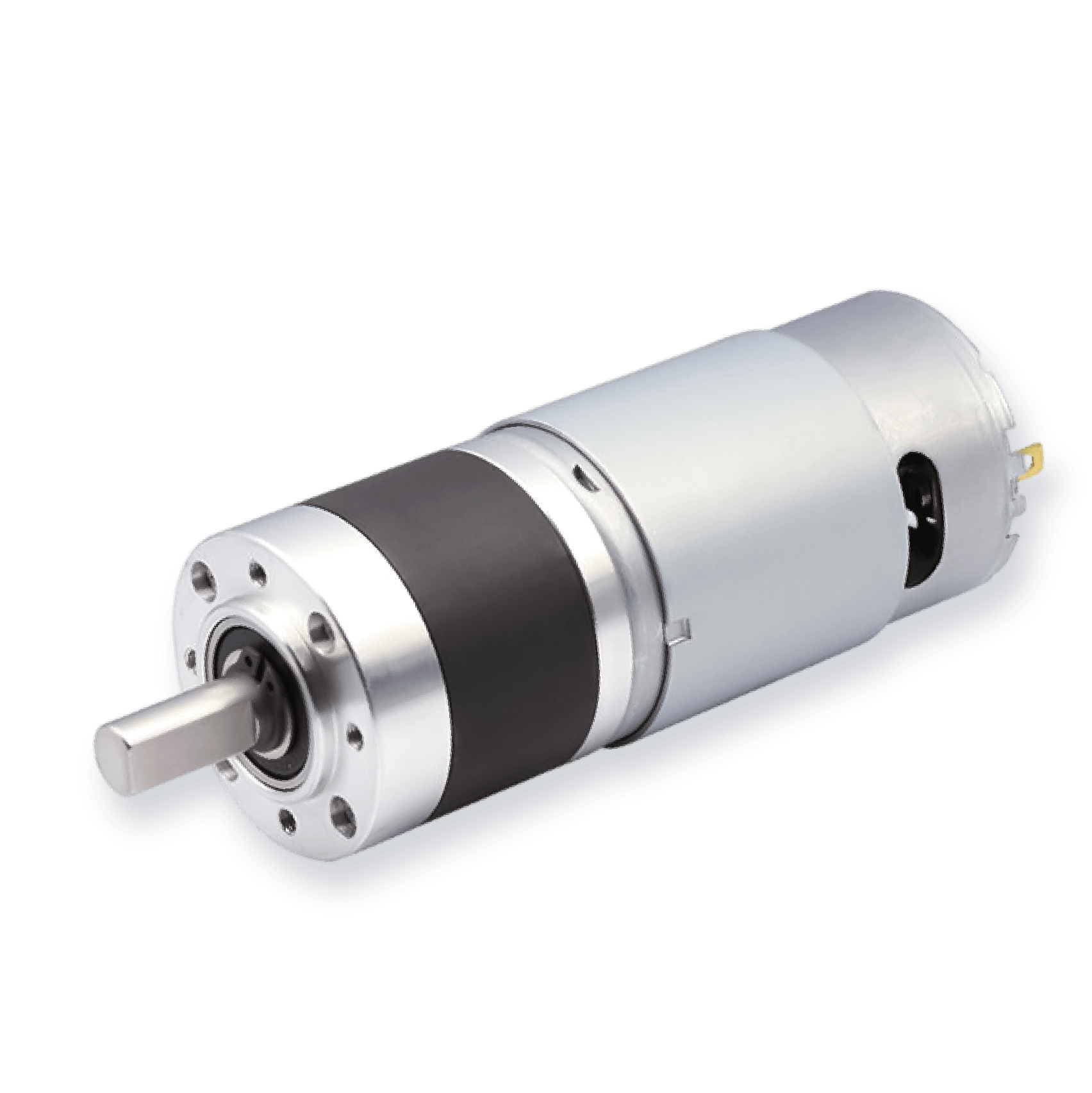
A planetary gear motor is a DC or BLDC motor paired with a planetary gearbox — a sun gear, a set of planet gears, and a ring gear arranged around one centerline. A single stage typically delivers a 3:1 to 10:1 speed reduction; stacking two or three stages multiplies that further, which is why the layout turns up in robot joints, medical pumps, and automation actuators where torque and space are both tight.
What Is a Planetary Gear Motor?
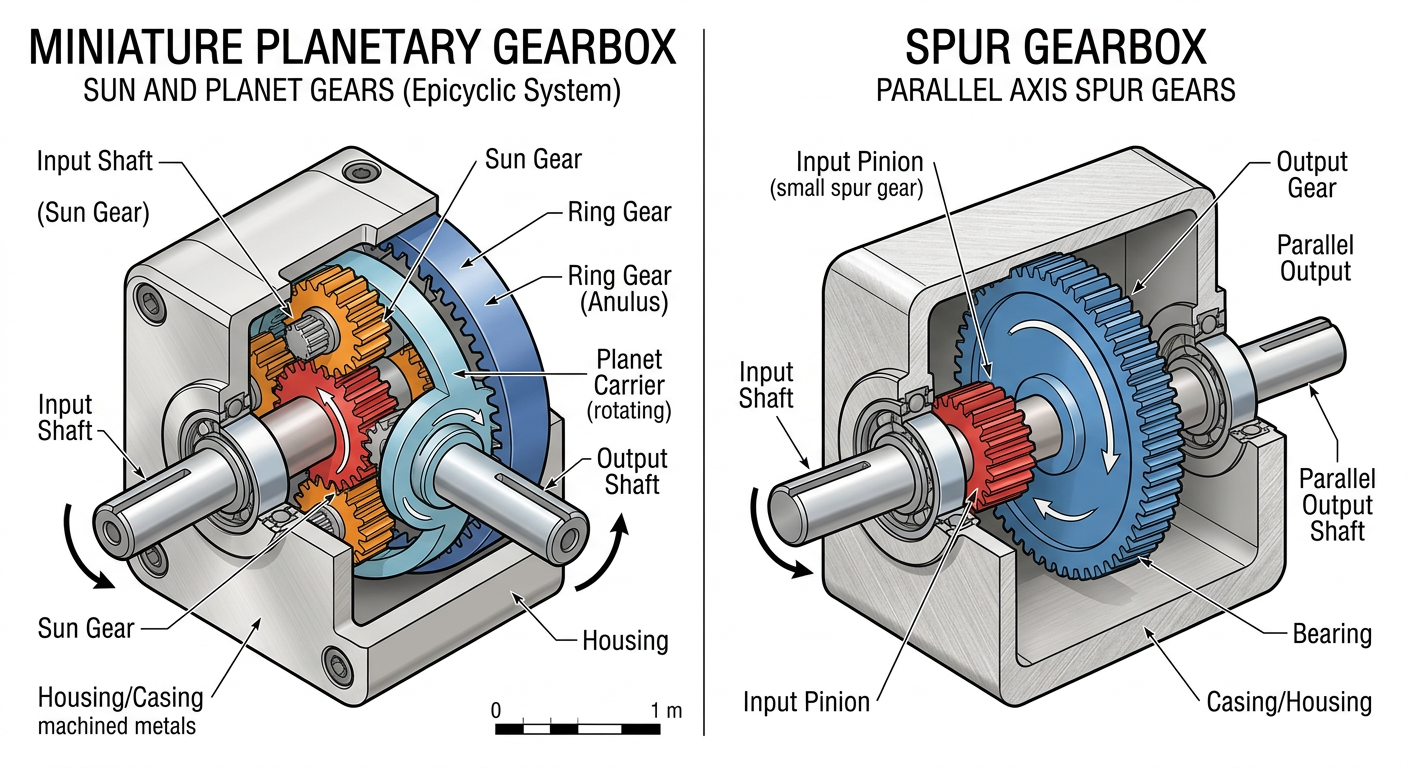
Inside the gearbox sit three gear families. The sun gear sits at the center and is driven directly by the motor shaft. The planet gears — usually three of them — mesh with the sun gear and orbit around it. The ring gear surrounds the assembly, stays fixed, and meshes with the outer edge of the planet gears, forcing them to orbit instead of spin freely. The planet gears sit in a carrier, and in most gear motors that carrier becomes the output shaft. Because the gears nest inside each other rather than lining up side by side, the reduction stage stays close to the motor's own diameter.
How Does a Planetary Gear Motor Work?
The motor shaft spins the sun gear. The sun gear drives the planet gears, which mesh with the fixed ring gear on their outer teeth and have nowhere to go but around — they orbit the sun gear the way planets orbit a star. The carrier, linked to all the planet gears, rotates far slower than the sun gear and becomes the output shaft.
The ratio of a single stage follows:
i = 1 + (Zring ÷ Zsun)
where Zring and Zsun are the tooth counts of the ring and sun gears. A ring gear with 60 teeth and a sun gear with 20 teeth gives i = 1 + (60 ÷ 20) = 4:1. When an application needs more reduction than one stage provides, a second or third stage is added in series — the output carrier of one stage becomes the sun gear input of the next, and the ratios multiply together.
The input (motor shaft) and output (carrier shaft) share the same centerline throughout this process, which keeps the gearbox in line with the motor instead of offset beside it or bent at an angle.
What Is the Purpose of Planetary Gears?
The purpose of planetary gears is to reduce rotational speed and increase torque while sharing the load across multiple gear teeth at once, inside a housing that stays coaxial with the motor and compact for the torque it delivers.
That single design choice does four jobs at once:
- Torque amplification — slower output speed converts spare motor rpm into usable shaft torque.
- Speed reduction — brings a motor's naturally high rpm down to a usable range.
- Load distribution — two or more planet gears carry the load together, so each tooth sees less stress than in a single gear pair carrying the same torque.
- Compact, coaxial form factor — the nested layout keeps the gearbox roughly motor-diameter, in line with the shaft.
Key Components of a Planetary Gear Motor
- Sun gear — small central gear, driven directly by the motor shaft.
- Planet gears — typically three gears meshing with both sun and ring, orbiting as the sun turns.
- Planet carrier — holds the planet gears and usually becomes the output shaft.
- Ring gear — outer, internally-toothed gear that stays fixed and forces the orbiting motion.
- Output shaft — connected to the carrier, delivers the reduced-speed, higher-torque rotation.
Gear sets and housings are commonly made from brass, stainless steel, powder-metallurgy alloys, or engineering plastics. Metal gear sets generally hold up to higher torque and more duty cycles; plastic gear trains are lighter and quieter for lower-load work.
Planetary vs. a Simple Gear Pair
A single gear pair can reduce speed and add torque too, and it's cheaper to make. The difference is in how load travels through the teeth: a gear pair puts the full load on one meshing pair, while a planetary train spreads the same load across two to five meshes, so a planetary gearbox delivers more torque for a given housing size. The trade-off is more gear meshes and slightly tighter manufacturing tolerances.
Worm gearboxes self-lock, unlike planetary gear trains, holding a load in place without power once the motor stops — a mechanism detailed in the worm gear motor guide. For a fuller comparison against worm, spur, and right-angle designs on efficiency, backlash, and cost, see planetary gear motor vs. other gear types.
Common Applications of Planetary Gear Motors
- Robotics — joint actuators and grippers needing torque density in a tight housing.
- Automation — feed mechanisms, valve actuators, positioning stages.
- Medical devices — dosing pumps and surgical tool actuation needing quiet, precise motion.
- Smart devices and precision equipment — compact drives for instrumentation and consumer hardware.
How to Choose the Right Planetary Gear Motor
Before requesting a quote, pin down: required torque and speed at the output shaft, supply voltage, gear ratio (single-stage or multi-stage), envelope size, brushed vs. brushless, and whether the application needs encoder feedback for closed-loop control.

Once those numbers are settled, browse our planetary lineup for custom ratios, voltages, and encoder integration, or explore the full Planetary Gear Motors range directly. To narrow down a configuration for your torque, speed, and envelope targets, request a quote and an engineer will review it with you.
FAQ
What is the purpose of planetary gears?
Planetary gears reduce speed and multiply torque while spreading the load across several planet gears instead of one gear pair, keeping input and output shafts coaxial. That load-sharing lets a planetary gearbox handle more torque than a similarly sized single-pair gearbox.
What does "planetary" mean in planetary gear motor?
The name describes how the planet gears move: they mesh with a central sun gear and orbit around it while also spinning on their own axis, similar to how planets orbit a star while rotating. The fixed outer ring gear is what forces that orbiting motion.
How much torque can a planetary gear motor produce?
Output torque ranges widely with size and stage count — from under 1 N·cm in small instrument-grade units to several hundred N·cm in larger multi-stage industrial gearboxes. Gear material and number of stages both raise the ceiling a given housing can handle.
What is a gear ratio in a planetary gearbox?
It's how many times the sun gear (input) turns for one turn of the carrier (output), calculated as i = 1 + (ring teeth ÷ sun teeth). A 60-tooth ring with a 20-tooth sun gives a 4:1 ratio per stage; stacking stages multiplies the ratios together.
Are planetary gear motors more efficient than spur gear motors?
Per-stage efficiency is comparable — roughly 90–97% for a well-made planetary stage versus roughly 90–95% for a single spur stage. The planetary advantage is torque density and a coaxial shaft, not a large efficiency gap; each added planetary stage costs a few more efficiency points.
Can a planetary gear motor be brushless?
Yes — planetary gearboxes pair with brushed DC, brushless DC (BLDC), and coreless motors alike. The gearbox mechanism doesn't care which motor drives the sun gear, so the brushed-versus-brushless choice comes down to lifespan, speed control, and drive electronics.
What materials are planetary gears made from?
Common options include brass, stainless steel, powder-metallurgy alloys, and engineering plastics. Metal gear trains typically hold backlash to around 1° or less and suit higher torque, while plastic gear trains run higher backlash (roughly 2–5°) but are lighter and quieter.
How long do planetary gear motors last?
Lifespan depends on load, duty cycle, and gear material more than on the planetary layout itself. Metal gear trains with proper lubrication are generally built for long life cycles under sustained loads; see extending DC gear motor lifespan for wear signs to watch for.
What size planetary gear motors are available?
Across the market, planetary gear motors commonly range from around 6mm in diameter for compact medical and instrument devices up to 100mm or more for automation and industrial drive tasks. Check individual model datasheets against your space constraints.
Do planetary gear motors need maintenance?
Sealed, properly lubricated planetary gearboxes are largely maintenance-free under normal duty cycles. Heavy loads, high duty cycles, or harsh environments call for periodic inspection of backlash and lubrication.
Ready to size a planetary gear motor for your project? Contact SLW Motor with your torque, speed, and envelope targets.